Precision in the Clouds
Precision in the Clouds: The Critical Role of Pitot/Static and Transponder Certifications
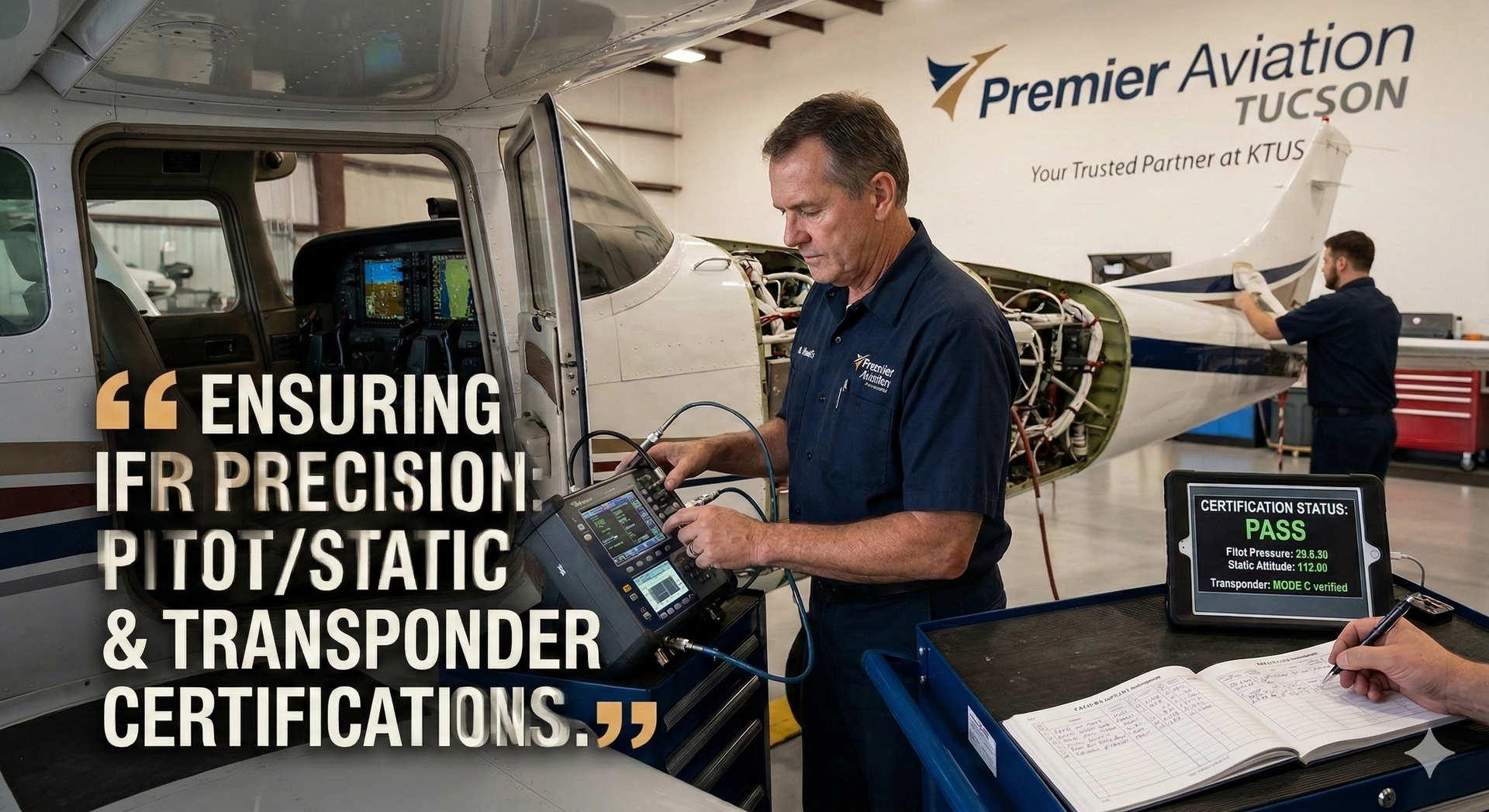
For pilots operating under Instrument Flight Rules (IFR), the cockpit instruments are more than just gauges—they are a lifeline. When flying through clouds or low-visibility conditions, your ability to maintain altitude, airspeed, and separation from other aircraft depends entirely on the accuracy of your Pitot/Static system and your transponder.
At Premier Aviation Tucson, these biennial certifications are a core service offering, ensuring that every "IFR-equipped" aircraft meets the rigorous safety standards mandated by the FAA.
What is a Pitot/Static System?
The Pitot/Static system is a network of pressure-sensitive instruments that tell you how fast you are going and how high you are flying. It consists of two primary components:
- The Pitot Tube: Usually mounted on the wing or nose, it measures "ram air" pressure to determine Airspeed.
- Static Ports: Flush-mounted sensors that measure the ambient atmospheric pressure to drive the Altimeter and Vertical Speed Indicator (VSI).
Why the Check is Essential
Over time, seals can degrade, hoses can crack, and small insects (like mud daubers) can obstruct the ports. A microscopic leak in a static line can cause an altimeter to read several hundred feet off—a terrifying prospect when shooting an instrument approach in "the soup."
Understanding FAA Regulations: 91.411 and 91.413
To fly in controlled airspace or under IFR, the FAA requires two specific certifications every 24 calendar months:
1. The Altimeter and Static System Check (FAR 91.411)
This test ensures the altimeter is accurate across its entire operating range. Technicians use specialized test equipment to simulate various altitudes, verifying that the instrument stays within specific tolerances. We also perform a Static Pressure System Leak Test to ensure the integrity of the plumbing behind the panel.
2. The Transponder Check (FAR 91.413)
Your transponder is what makes you visible to Air Traffic Control (ATC) and other aircraft equipped with TCAS (Traffic Collision Avoidance Systems). This check verifies:
- Frequency and Power: Ensuring the signal is strong and on the correct channel.
- Mode C/S Correspondence: Confirming that the altitude reported by your "blind encoder" matches the altitude shown on your primary altimeter. If these don't match, ATC might see you at 5,500 feet while you think you are at 5,000 feet.
The Premier Aviation Advantage: Precision Calibration
At Premier Aviation, we don't just "pass or fail" your aircraft. Our specialized technicians use state-of-the-art air data test sets to provide a high-fidelity calibration.
- Integrated Troubleshooting: If a leak is detected, we don't just tell you it failed; we find the source—whether it’s a cracked O-ring or a faulty encoder—and fix it on-site.
- Modern Avionics Expertise: With the shift toward ADS-B Out, your transponder and GPS must talk to each other perfectly. We ensure your digital "signature" in the sky is accurate and compliant.
- Efficiency: We understand that downtime is the enemy of any pilot. We've streamlined our certification process to get your IFR sign-off completed accurately and back in the logbooks quickly.
Conclusion: Safety Beyond the Logbook
While a Pitot/Static and Transponder check is a legal requirement, its true value is peace of mind. Knowing that your "six-pack" or digital flight display is giving you the ground truth allows you to focus on the mission: flying the airplane safely to your destination.