
Aircraft Corrosion: Silent Danger in Tucson Skies
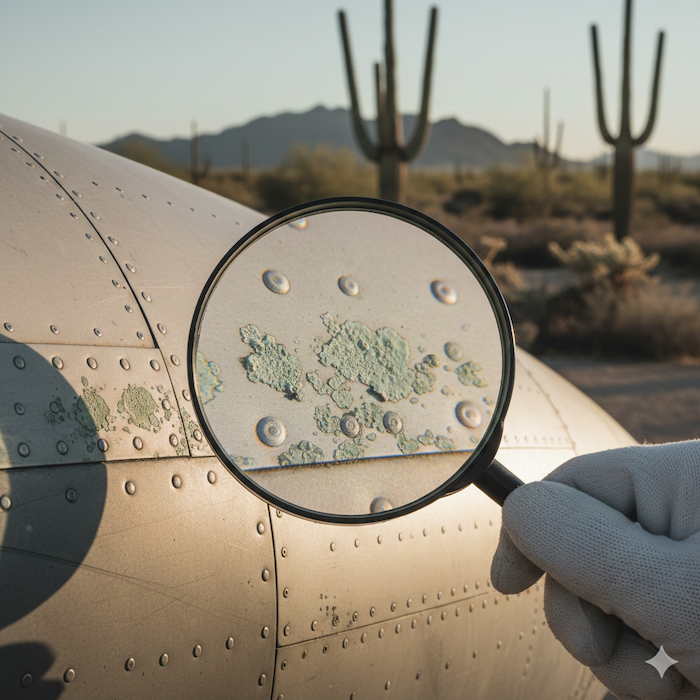
Monsoon Season Corrosion Watch: A Tucson Owner's Seasonal Maintenance Calendar
Most corrosion advice treats it as a year-round, one-size-fits-all threat. In Tucson, it isn't. Corrosion risk to your aircraft spikes hard for about ten weeks a year — and if you're only inspecting on your normal annual schedule, you're missing the window where damage actually takes hold. This is your seasonal timing guide: what changes during monsoon season, and exactly when to act.
Why Monsoon Season Changes the Corrosion Equation
From roughly late June through September, Tucson's humidity swings dramatically compared to the rest of the year. Sudden moisture spikes combine with the desert dust already coating your airframe, and that combination — trapped moisture plus particulate — is exactly the electrolyte environment corrosion needs. The other ten months of dry heat, corrosion risk is comparatively low. This narrow window is where most of the year's damage actually begins, even though it often isn't discovered until much later.
The 3-Phase Seasonal Calendar
Phase 1: Pre-Monsoon Prep (Late May–Early June)
Before the first storms roll in, this is your window to get ahead of the season. Reapply corrosion-inhibiting compounds (CICs) to known trouble spots, confirm every drain hole and vent is fully clear, and touch up any chipped paint now — a bare scratch that's fine in dry April becomes an entry point once humidity arrives.
Phase 2: During Monsoon Vigilance (July–September)
This is the only stretch of the year we recommend inspecting more frequently than your normal schedule. After any significant storm or period of high humidity, do a quick walk-around focused on wheel wells, lap joints, and the belly — the areas where wind-driven moisture and dust settle fastest. You're not doing a full inspection each time, just watching for new discoloration, bubbling paint, or grit buildup in drainage points.
Phase 3: Post-Monsoon Recovery (October)
Once the season breaks, this is when a full, thorough inspection matters most — checking everything the summer humidity may have started before the dry season locks moisture in place or masks it. Anything caught now is far cheaper to address than damage found six months later during your next annual.
What Actually Changes About Your Routine
Outside of monsoon season, a standard periodic inspection is sufficient. During it, the difference is frequency and focus — not new tools or a longer checklist, just more eyes on the specific areas most exposed to wind-driven moisture during and right after storms. For a full point-by-point inspection walkthrough, our aircraft corrosion inspection checklist covers every area to check in detail.
When to Call In a Professional
If a post-storm walk-around turns up anything beyond surface dust — bubbling paint, white or reddish deposits, or stiffness in a control surface — stop and have it evaluated before the next flight. Monsoon-driven corrosion can progress faster than the dry-season kind because the moisture doesn't evaporate as quickly once it's trapped under a coating or inside a joint.
Want the full picture on how corrosion forms and progresses in aircraft generally, not just seasonally? Read our complete guide on aircraft corrosion: the unseen danger in AZ skies.
Contact Premier Aviation Tucson to schedule your pre- or post-monsoon corrosion inspection.
New Paragraph
Does the dry Tucson climate really pose a corrosion risk to my aircraft?
Yes. While the low humidity helps, Tucson experiences significant temperature swings that lead to condensation (dew) inside wings and fuselages. Additionally, dust and desert particulates can trap moisture against metal surfaces, and monsoonal moisture provides the perfect electrolyte for electrochemical reactions to occur.
How often should I have my aircraft inspected specifically for corrosion?
While your annual inspection covers major structural integrity, we recommend a dedicated corrosion "walk-around" every 4–6 months. If you frequently fly to coastal regions or leave your aircraft outside on the ramp, more frequent checks are necessary.
What is the most common place corrosion hides in general aviation aircraft?
It often hides in "lap joints" where two sheets of aluminum overlap, under floorboards where spilled liquids or condensation collect, and inside the tail cone. These areas are often overlooked during casual pre-flight inspections.
Can I just paint over a small spot of corrosion myself?
No. Painting over corrosion is like putting a bandage over an infected wound; it will continue to eat away at the metal underneath, often faster because the moisture is now trapped. The corrosion must be mechanically or chemically removed, the metal neutralized, and a proper zinc-chromate or epoxy primer applied before touch-up paint.
Are certain aircraft models more prone to corrosion than others?
Some older legacy aircraft lacked the internal zinc-chromate priming that modern aircraft receive at the factory. Aircraft with "piano hinges" (like those found on many Beechcraft or Cessnas) are also high-risk areas that require frequent lubrication and inspection.
Contact Premier Aviation Tucson for any of your aviation repair needs.
Learn more about our aircraft corrosion services.
If you ar looking for these Related Keywords and Hashtags you'll find the answers in this article.
- Aircraft corrosion
- Aviation maintenance Tucson
- Aircraft repair Tucson
- Corrosion prevention aircraft
- Aircraft inspection AZ
- Aircraft safety Tucson
- Airplane corrosion
- General aviation maintenance
- Aircraft structural repair
- Premier Aviation Tucson
- #AircraftCorrosion
- #AviationSafety
- #AircraftMaintenance
- #TucsonAviation
- #PremierAviation
- #AircraftRepair
- #FlightSafety
- #CorrosionPrevention